President Bola Ahmed Tinubu has given Nigeria’s defence, intelligence and security chiefs a 90-day deadline to produce a comprehensive National Threat Assessment and a Five-Year Strategic Defence Operations Plan aimed at strengthening the country’s response to emerging security threats, Peak Newspaper reports.
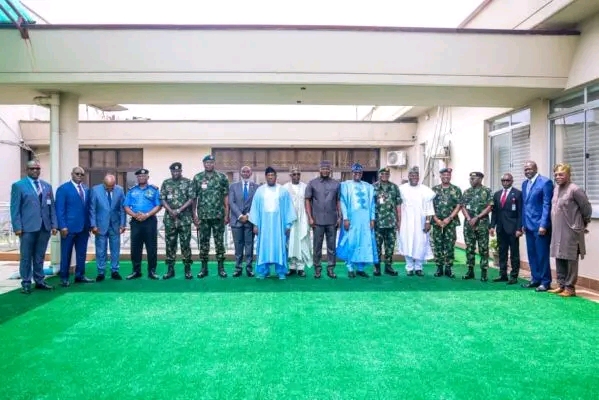
The Secretary to the Government of the Federation (SGF), George Akume, disclosed this on Wednesday while inaugurating the Presidential Committee on National Threat Assessment and Five-Year Strategic Defence Operations Plan on behalf of the President.
The committee brings together the National Security Adviser (NSA), ministers, service chiefs and heads of major security and intelligence agencies.
According to Akume, the initiative is designed to move Nigeria’s security strategy away from mainly reacting to attacks after they occur towards a system capable of anticipating threats, identifying priorities and deploying resources more effectively.
He charged members of the committee to approach the assignment with professionalism, objectivity, urgency and patriotism, stressing that the two documents must be completed and submitted within 90 days for President Tinubu’s consideration and approval.
The SGF did not state whether sanctions would be imposed if the committee fails to meet the deadline.
Move Comes Amid Renewed Security Concerns
The committee was inaugurated a day after President Tinubu expressed concern over the latest mass abduction and killing of residents in Niger State.
The President subsequently directed the Armed Forces, Nigeria Police Force, Department of State Services (DSS) and other security and intelligence agencies to commence a coordinated operation to rescue those abducted.
Tinubu also ordered the service chiefs to provide regular updates on the rescue efforts until all the victims are accounted for.
Describing the attackers as “enemies of peace and enemies of humanity,” the President vowed that those responsible would face consequences.
The latest incident has further heightened concerns over persistent kidnappings and violent attacks in parts of the North-West and North-Central regions, where armed groups have targeted communities, highways and places of worship.
The North-East also continues to face insurgency despite years of military operations against terrorist groups.
Government Seeks Shift From Reaction to Prevention
Speaking during the committee’s inauguration, Akume said the increasingly complex and interconnected nature of modern security threats required a more coordinated national strategy.
He acknowledged the successes recorded by the military and other security agencies but argued that Nigeria could no longer depend mainly on responding to threats after they had already emerged.
He said the country needs a security system capable of anticipating threats, prioritising risks, allocating scarce resources efficiently and maintaining operational momentum.
According to him, defence, intelligence and security operations must be based on a common understanding of Nigeria’s security environment and supported by coherent short-, medium- and long-term strategies.
Akume also expressed concern that operational needs are sometimes considered separately by individual institutions without enough reference to a common national threat assessment or unified capability plan.
He warned that such an approach could affect coordination and result in inefficient use of limited resources.
He said the new framework would establish a direct connection between identified threats, operational objectives, military capabilities, available resources and measurable results.
“In simple terms, we must establish a clear path from threat to objective, from objective to capability, from capability to resource, and from resource to measurable outcome,” he said.
What the National Threat Assessment Will Cover
The National Threat Assessment is expected to provide an objective assessment of Nigeria’s security environment.
It will identify both existing and emerging threats, examine their possible strategic consequences, assess how they could develop and determine appropriate government responses.
The assessment is also expected to help security agencies distinguish between immediate threats that require urgent intervention and emerging risks that require early investment in areas such as intelligence, technology, infrastructure and training.
Five-Year Defence Plan to Guide Resources
The Five-Year Strategic Defence Operations Plan, meanwhile, will translate the threat assessment into specific operational requirements.
These will include identifying the personnel, equipment, intelligence capabilities, infrastructure, logistics and technology required across Nigeria’s various operational theatres.
The plan is also expected to identify capability gaps and establish procurement priorities based on assessed security threats rather than the individual preferences of institutions.
Akume said the five-year framework would provide a medium-term basis for force development, equipment acquisition, infrastructure, training, maintenance, research and development, as well as strengthening Nigeria’s defence industrial base.
However, he explained that the plan would not remain static, as it would operate on a **rolling basis and undergo annual reviews** to reflect new threats, technological developments, changing operational conditions and lessons from ongoing operations.
The committee is also expected to establish implementation timelines, assign responsibilities, develop monitoring mechanisms and recommend ways of measuring outcomes.
Committee Members
The committee will be coordinated and supported by the Office of the President’s Special Adviser on Homeland Security, Major General Adeyinka Famadewa (retd.).
Members include:
* National Security Adviser, Nuhu Ribadu
* Minister of Defence, General Christopher Musa (retd.)
* Minister of State for Defence, Bello Matawalle
* Chief of Defence Staff, General Olufemi Oluyede
* Chief of Army Staff, Lt. General Waidi Shaibu
* Chief of Air Staff, Air Marshal Sunday Kelvin Aneke
* Chief of Naval Staff, Vice Admiral Idi Abbas
* Inspector-General of Police, Olatunji Rilwan Disu
* Director-General of the DSS, Tosin Ajayi
* Director-General of the National Intelligence Agency, Ambassador Muhammed Muhammed
Famadewa, in his closing remarks, described the assignment as a shared national responsibility.
He said his role would be to facilitate cooperation among members and draw on their collective expertise rather than operate as the commander of the committee.
He added that specialised subcommittees would be created to handle different areas of the assignment and ensure that the two strategic documents are completed within the 90-day deadline.