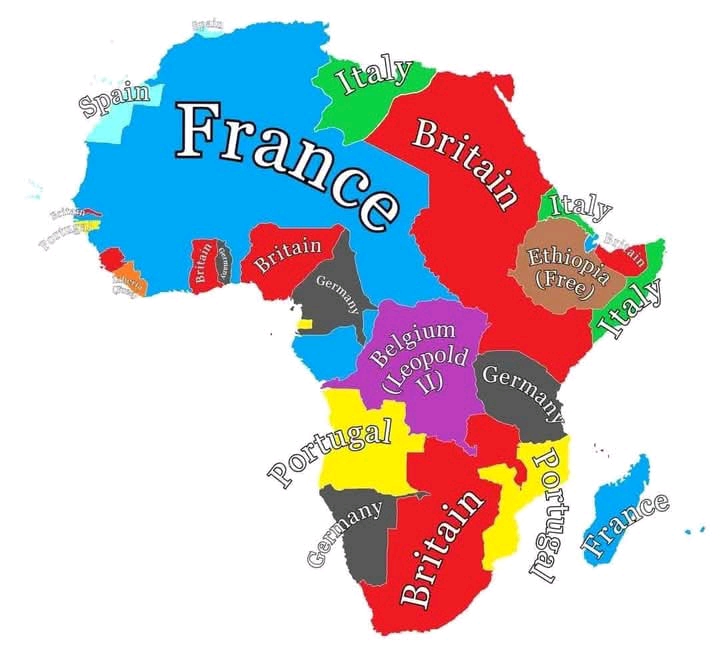
Nigerian human rights activist and former senator, Shehu Sani, has reignited conversations about Africa’s colonial past after sharing a color-coded map illustrating how European powers divided the continent during the Berlin Conference of 1884–1885, Peak Newspaper reports.
The map, which visually breaks down Europe’s colonial claims, shows France controlling vast territories in West and Central Africa, Britain dominating East and Southern Africa, while Germany, Portugal, Belgium, Italy, and Spain carved out smaller zones. Notably, Ethiopia stood as the only major African nation that remained independent during the colonial rush.
The Berlin Conference—convened by German Chancellor Otto von Bismarck—was held without any African representation or consent, and it formalized what became known as the “Scramble for Africa.” European nations drew arbitrary borders that cut across more than 1,000 ethnic groups, ignoring cultural and linguistic boundaries.
Historians note that these artificial borders have had lasting consequences. Research published in the Journal of African History links such colonial-era partitions to civil conflicts in nearly 40% of modern African states, where ethnic groups were split or forced together by European boundary lines.
Reactions to Sani’s post were mixed. Some users highlighted the brutality and exploitation that followed colonization, while others pointed out earlier and parallel systems of oppression, such as the Arab slave trade. Others drew comparisons to post-World War II border adjustments, where colonial powers made limited territorial changes through plebiscites but largely preserved the same colonial map.
Sani’s post aligns with his long-standing advocacy for national unity and reform in Nigeria, where he often warns that the legacy of colonialism still shapes ethnic divisions and political instability today.
“Africa is still healing from lines drawn in Berlin,” one commenter wrote, echoing the sentiment of many who viewed the post as a call for deeper continental introspection and renewed efforts toward unity and self-determination.