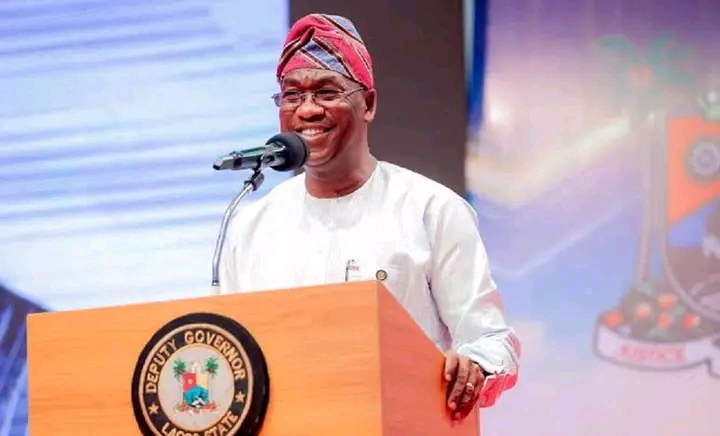
Lagos State Deputy Governor and All Progressives Congress (APC) governorship candidate, Obafemi Hamzat, has unveiled a 30-year development plan for the state, with human capital development, infrastructure, housing, flood control, waste management and security as key priorities, Peak Newspaper reports.
Hamzat, who spoke on TVC News’ Journalists’ Hangout, said the long-term plan was designed to prepare Lagos for its rapidly growing population and position the state as a global centre for talent, innovation and economic opportunities.
He said the state could no longer rely solely on short-term interventions to address challenges arising from population growth.
“We have a development plan for the next 30 years,” he said.
Hamzat identified human capital development as a major component of the plan, saying Lagos must equip its young population with skills required in the global economy.
“Lagos must become the human capital of the world,” he said.
He said companies operating in the state sometimes struggled to find workers with the required skills despite the large number of graduates available.
“How do we match skills with talent? That must be our next target,” he said.
According to him, young Lagosians should be trained in emerging fields such as artificial intelligence, cybersecurity and blockchain technology to enable them compete for opportunities globally.
Hamzat also spoke on the growing “Japa” trend, saying government could not stop people from relocating, but could equip residents with skills to compete in the international labour market.
“We know Japa will always be there. People with Japa, we cannot stop human beings from moving,” he said.
He added that Lagos should focus on producing skilled workers capable of securing jobs globally, including through remote employment.
Hamzat also warned that officials who approve buildings on flood-prone areas will be tracked and punished as the state strengthens its planning and monitoring systems.
He said the state was upgrading its Geographic Information System (GIS) to electronically monitor developments and identify officials responsible for approvals.
“We are now making sure that it is now electronic and therefore we can track people and the moment you are able to track people, you know who is responsible for A and B and people will face penalties,” he said.
The APC candidate condemned the practice of approving structures that fail to meet planning requirements.
“I’ve listened to people say, ‘Oh, it’s not approvable but it’s buildable.’ That’s absolutely not acceptable. Whatever is not approvable should not be buildable because we hurt others when we do that. You build on a drain and the whole community floods,” he said.
Hamzat said officials responsible for developments that worsen flooding would face sanctions.
He attributed flooding in Lagos to a combination of the state’s geography, heavy rainfall, changing weather patterns and human activities.
According to him, Lagos is, on average, about two metres below sea level and has seven drainage systems designed to channel water into receiving bodies, including creeks and lagoons.
He said heavy rainfall occurring alongside high water levels in receiving channels could result in tidal locking and temporary backflow.
“The challenge is when those drains are not clear,” he said.
Hamzat disclosed that 1,000 people had been deployed under the state’s environmental flood management efforts to clear drainage channels.
He urged residents to stop dumping refuse into drains, warning that such practices could undermine government’s efforts to improve drainage.
He also advocated the use of technology, including sensors in underground drainage systems, to detect blockages.
“We just need to use technology a bit better,” he said.
The deputy governor said the state was expanding drainage infrastructure and dredging waterways to improve the movement of floodwater.
He disclosed that the Ikota River was being dredged to increase its capacity to receive water from parts of Lagos Island.
Hamzat added that the state’s drainage master plan, currently reviewed every five years, might be reviewed more frequently in response to climate change.
“So maybe because of climate change, we need to take it to three years,” he said.
On housing, Hamzat said Lagos’ population growth required a more aggressive approach to housing delivery.
He advocated increased vertical development in areas outside the traditional high-value locations, saying the state could no longer depend largely on horizontal expansion.
“We are going up in terms of building. We are going up in Ikoyi, but we need to go up in Igando, Iyana-Ipaja, Shibiri too,” he said.
He called for expansion of mortgage financing to make home ownership more accessible to residents.
Hamzat disclosed that about 19,000 housing units had been delivered in the state within three years, while estimating that Lagos required about 40,000 units.
He said stronger collaboration between developers and mortgage institutions would help residents access affordable housing.
Hamzat said waste management would also form a major part of the proposed long-term development strategy.
He said Lagos must move beyond merely disposing of refuse and begin treating waste as an economic resource capable of generating energy and creating employment.
According to him, between 300 and 320 trucks enter the Olusosun landfill daily.
He said the access road to the landfill had been repaired, while the number of tipping points was being increased from two to four to reduce the time spent by waste trucks at the facility.
He disclosed that a transfer loading station being developed at Olusosun would have the capacity to handle about 2,500 metric tonnes of waste daily.
Hamzat also disclosed plans for four transfer stations across the state, alongside material recovery facilities and a waste-to-energy plant in Alimosho.
He said the initiatives would reduce pressure on landfills, while enabling the state to recover recyclable materials and generate energy from waste.
The APC candidate said about 13,000 people currently involved in waste sorting could be formally integrated into the system through training and provision of equipment.
“We must get them into the system, train them, equip them. It is job opportunities,” he said.
He also advocated waste separation at source, saying proper sorting could help reduce the cost of waste management.
Hamzat linked job creation to security and social stability, saying Lagos’ large youth population must have access to meaningful economic opportunities.
“When we are able to provide jobs for our people, there will be peace,” he said.
He said the state must also prepare for emerging forms of crime by deploying technology and strengthening its security architecture.
“Lagos will be ready for the crimes of the future,” he said.
On healthcare, Hamzat said no resident should be forced into financial hardship because of illness.
“No one in Lagos should go to ruin because they are ill,” he said.
The APC candidate expressed confidence in President Bola Ahmed Tinubu’s chances of securing re-election in 2027.
He argued that the political circumstances surrounding the 2023 presidential election had changed, saying Nigerians would increasingly assess the administration based on its policies and performance.
For Hamzat, the broader challenge is how to build a Lagos capable of absorbing its growing population while providing jobs, housing, mobility, security and a healthy environment for residents.
His proposed 30-year plan seeks to address those challenges through long-term investments in human capital, infrastructure, flood control, housing, waste management, security and healthcare.