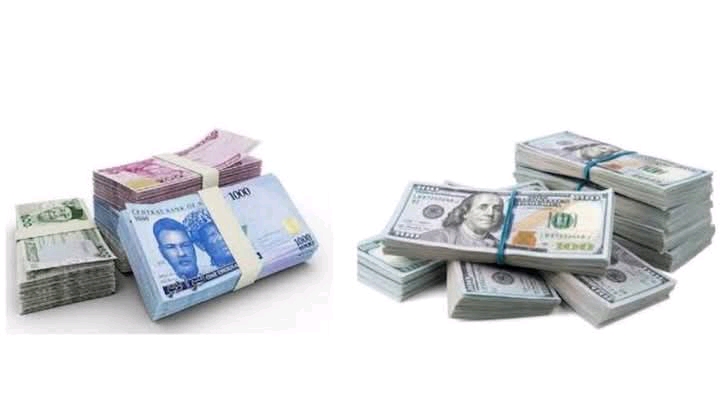
The Federal Government has approved an exchange rate benchmark of N1,512 to the dollar for the 2026 fiscal year under its Medium-Term Expenditure Framework and Fiscal Strategy Paper covering 2026 to 2028, Peak Newspaper reports.
The new rate, higher than the 2025 benchmark of N1,400, will guide key assumptions in the upcoming Appropriation Bill, alongside fresh oil, revenue and growth projections.
Presenting the framework in Abuja, Minister of Budget and Economic Planning, Abubakar Atiku Bagudu, announced a conservative oil price benchmark of 64.85 dollars per barrel. He said the document was developed with ministries, the private sector, civil society groups and development partners and will be transmitted to the National Assembly on December 8.
Bagudu explained that the MTEF adopts two crude oil production figures. The target is 2.06 million barrels per day. The budgeting benchmark is 1.80 million barrels per day to avoid revenue shocks. He noted that although Nigeria’s Bonny Light sells at a premium, government pegged the benchmark below average trading prices for caution.
The minister added that pre-election spending in 2026 may influence currency behaviour, making a realistic FX benchmark necessary.
Under the new projections, gross federation revenue is estimated at N50.74 trillion. From this, the federal government is expected to receive N22.60 trillion, states N16.30 trillion and local governments N11.85 trillion.
Federal revenue for 2026 is projected at N34.33 trillion, including N4.98 trillion from government-owned enterprises, representing a sixteen percent drop from the 2025 estimate.
Major spending items in the fiscal plan include statutory transfers of about N3 trillion, debt service of N15.91 trillion and non-debt recurrent expenditure of N15.27 trillion. With a projected deficit of N20.10 trillion, the total federal spending envelope stands at N54.43 trillion.
Meanwhile, Nigeria’s external reserves rose to 43 billion dollars, driven by crude oil inflows, diaspora remittances and renewed foreign portfolio investment. Analysts say the uptick strengthens the country’s ability to stabilise its currency and meet external obligations.